

Introduction
The telecom industry is undergoing a profound shift as AI agents move from experimental demonstrations to real operational enablers. After years of relying on static automation and rule based workflows, operators are now exploring agentic systems capable of understanding intent, accessing multiple data sources, and executing tasks autonomously. These AI agents promise a stepchange in how networks are operated. Instead of navigating dozens of tools, interfaces, and dashboards, teams can delegate complex, multi step tasks to an intelligent assistant that can plan, reason, and act across domains.
However, this shift has exposed a long standing challenge in Operations Support Systems (OSS) environments: fragmentation. Even within a single operator, critical functions such as assurance, fulfillment, diagnostics, and inventory often sit behind different APIs, data models, and integration patterns. While standardized interfaces, such as TM Forum’s Open API, have simplified access to services, every interaction still requires bespoke connectors, custom logic, and ongoing maintenance.
In parallel, many organizations began to experience vendor lock-in. Proprietary platforms offered powerful integrations but constrained flexibility, making it difficult to migrate or adapt solutions across different models.
As operators move toward AI native operations, this fragmentation becomes a major obstacle to scalability. The constant need to adapt integrations and retrain or update AI systems, systems that depend on clean, standardized access to tools and data, introduces operational uncertainty and technical debt. It’s within this context that the Model Context Protocol (MCP) emerged as a key enabling technology for standardizing interactions between AI agents and OSS environments.
What Is MCP and Why Does It Matter for OSS
MCP provides a universal, standardized way for Large Language Model (LLM) agents to interact with external tools, APIs, and data sources. By providing a unified framework for communication with data and tools, it expands LLM’s knowledge and enables it to address complex, real-world challenges more effectively. In addition, MCP reduces the need for agent-specific integration logic across vendor tools, simplifying how AI agents interact with already exposed services.
MCP servers operate with any system that supports the protocol, as illustrated in Figure 1., below. On the left side are the LLM applications that communicate with the MCP server, allowing the server and clients to exchange information and send requests back and forth. On the right side are data sources and tools, ranging from direct access to databases or filesystems to internal products or modules, allowing the server to retrieve and update information. In this approach, instead of dozens of custom integrations, agents gain a single, consistent interface to query information, run diagnostics, trigger actions, or coordinate workflows across OSS modules.
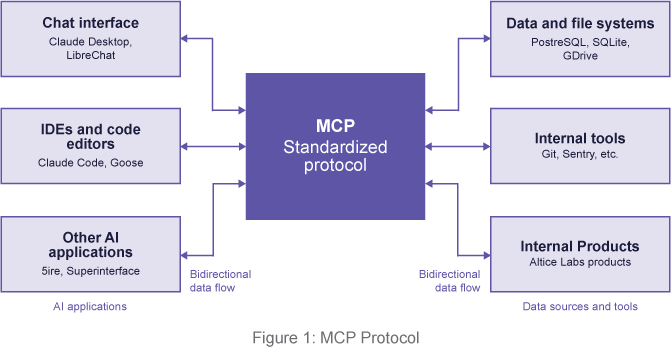
For OSS environments, this shift is more than a technical improvement; it is a catalyst for operational intelligence. MCP helps operators reduce fragmentation and vendor dependency, allowing organizations to build modular, portable, and future proof solutions. This standardization is particularly relevant in ecosystems where components across the entire OSS ecosystem (inventory, fulfillment, and assurance) need to interoperate seamlessly.
By exposing these capabilities as clear and semantically meaningful tools, MCP bridges the gap between natural language queries and structured API logic, ensuring agents can reliably select and execute the correct actions with accuracy.
This transformation becomes even more significant as operators move toward autonomous networks and adaptive, self governing OSS platforms. MCP accelerates the evolution from static, rule based automation to agentic AI, enabling systems that can sense, analyze, decide, and act autonomously across multiple operational domains. By reducing integration friction and unifying access to operational capabilities, MCP provides a foundational layer for scalable, intelligent autonomous networks, particularly in enabling standardized interactions between agents and OSS capabilities. It positions AI not as an add on or external layer, but as a native, context aware component embedded directly into how OSS systems communicate, reason, and operate.
NOSSIS One MCP Implementation
To bring the benefits of MCP into an operational OSS environment, Altice Labs implemented an approach that layers MCP interactions over the existing Open API interfaces of NOSSIS One, its AI-enabled OSS suite. Rather than rebuilding integrations or introducing proprietary mechanisms, this approach transforms existing NOSSIS One APIs into MCP compatible tools.
By converting API calls into MCP tools, the system gains flexibility, reduces integration complexity, and enables adaptive, goal oriented workflows. AI agents can execute actions, retrieve information, and coordinate processes across NOSSIS One modules through a consistent and structured interface. What previously required multiple custom integrations is now unified under a single, standardized model that supports scalable agentic behavior.
As a result, any MCP enabled agent, not just those within NOSSIS Genius (Altice Labs’ agentic AI framework for OSS), can interact seamlessly with NOSSIS One’s capabilities.
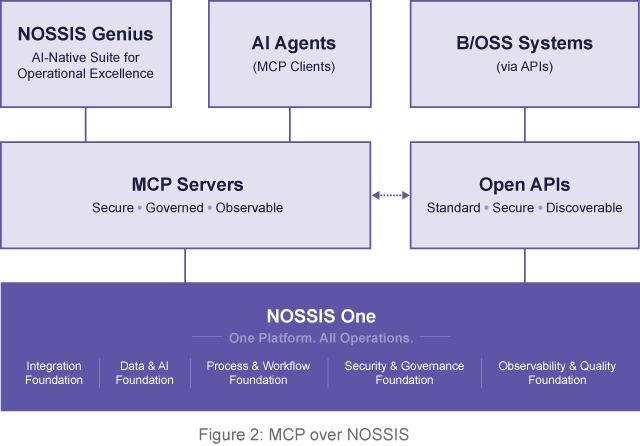
Ultimately, implementing MCP servers over TM Forum Open APIs, within the NOSSIS One ecosystem, delivers value well beyond the technical execution. It creates a more accessible, interoperable OSS environment where any MCP aware agent can orchestrate capabilities. Reducing integration friction paves the way for richer agentic use cases, from embedded assistants within each module to cross domain orchestration, bringing NOSSIS One closer to future autonomous operations.
Beyond the deployment of agents within NOSSIS One, the application of MCP servers also allows for the next strategic step towards an autonomous future, one in which there’s a global assistant capable of interacting with the entire ecosystem through a single conversational interface, where the user no longer needs to know where a specific capability resides, as the assistant dynamically orchestrates MCP tools across multiple domains.
Takeaways
The adoption of MCP servers marks a turning point in how OSS platforms evolve to support AI driven operations. By introducing a standardized interface between AI agents and operational systems, MCP removes long standing barriers created by fragmented integrations and siloed architectures. This shift enables operators to move beyond isolated automation use cases and toward a more cohesive modeling which intelligence is embedded directly into how systems interact, exchange data, and execute workflows.
Within NOSSIS One, this approach represents both a technical and strategic milestone. On the technical side, MCP provides a standardized interface that transforms fragmented API connections into a modular and interoperable layer. Business-wise, it reduces integration overhead, accelerates time to market for new workflows, and increases service quality and resilience. Together, these benefits position NOSSIS One not only as a future proof OSS platform but also as a pioneer of open AI native operations.
Beyond these immediate gains, by leveraging TM Forum Open APIs foundations and exposing them through MCP tools, the platform becomes more accessible and interoperable, opening the door to a wider ecosystem of AI agents. Combined with knowledge assistance, which provides the contextual layer required for accurate reasoning and decision making, this creates an environment where agents can act with both awareness and precision across complex operational scenarios.
Looking ahead, MCP lays the foundation for more adaptive and autonomous OSS environments. As adoption grows, focus will shift toward expanding use cases across domains, strengthening governance and observability, and enabling more advanced agent driven workflows featuring multiple-system orchestration. In this model, OSS platforms evolve beyond systems of execution to become intelligent environments, where AI, data, and tools work together to deliver more efficient, resilient, and user centric operations.
For more details, read the blog posts on NOSSIS Genius AI Studio.