
The challenge of AI in telecom deployment
Across the telecommunications industry, artificial intelligence (AI) has moved from experimentation to strategic priority. Operators are increasingly recognizing their potential to automate processes, improve efficiency, and enhance customer experience. Despite this momentum, a critical gap remains between AI ambition and real-world deployment.
Most organizations already have a clear view of where AI can create value. The challenge lies in execution. Bringing a new use case into production typically requires long development cycles, integration effort across multiple systems, and continuous support from vendors or system integrators. As a result, even simple ideas can take months to materialize.
At the same time, operational environments continue to evolve. Networks are becoming more complex, customer expectations are rising, and the need for real-time response is becoming the norm. In this context, static systems and slow delivery models are no longer sufficient.
The difficulty is no longer defining what AI should do, but enabling teams to build, adapt, and deploy AI capabilities fast enough to keep up with operational demands.
A shift toward agentic operations
To address this gap, the industry is moving toward a more dynamic model based on AI agents. Unlike traditional systems, these agents are designed to interact with users, reason over data, and execute actions across different platforms.
This shift introduces a new requirement. Instead of relying only on centralized development teams, organizations need the ability to create and adapt AI-driven capabilities continuously. The focus moves away from isolated implementations and toward an environment where new use cases can be built, governed, and deployed quickly.
Delivering this level of flexibility requires a different type of platform, one designed not just to run AI but to streamline its creation.
A platform for building and operating AI agents
NOSSIS Genius AI Studio addresses this gap by providing a platform for operators to design, deploy, govern, and run AI agents tailored to their operational requirements. Rather than treating AI as an external capability delivered through individual projects, NOSSIS Genius AI Studio brings it directly into the hands of operations teams. Users can define how agents behave, determine which systems they interact with, configure the tasks they perform, and manage their execution within a single environment.
NOSSIS Genius AI Studio is designed to operate as an over-the-top layer, enabling integration with existing Operations Support Systems (OSS) environments without requiring complex swap projects. This capability is particularly important in telecom environments, where legacy systems remain critical to daily operations. Instead of introducing disruption, it enhances these systems by enabling agents to interact with them directly.
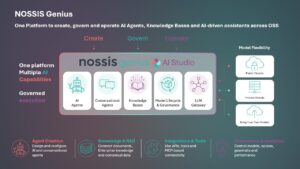
By using Open Application Programming Interfaces (APIs) and leveraging connectivity based on the Model Context Protocol (MCP), agents can access data, trigger actions, and orchestrate workflows across multiple platforms. This allows operators to introduce AI capabilities incrementally, building on top of their current architecture while preserving existing investments.
This is particularly relevant in telecom environments that already expose standardized interfaces, such as TM Forum Open APIs. When OSS platforms provide certified or well-aligned Open APIs, NOSSIS Genius AI Studio can significantly reduce the integration effort required to connect agents to operational systems. In these scenarios, pre-built agents can be deployed more quickly and start creating value from the earliest stages of adoption, using existing interfaces to retrieve data, drive operations, and coordinate workflows.
At the same time, the platform is not limited to predefined interfaces. Operators can also expose their own APIs, tools, or MCP servers and make them available to agents through NOSSIS Genius AI Studio. This allows each organization to extend agent capabilities according to its own systems, processes, and operational context.
The solution also provides core capabilities required to make agents useful in real operational environments. Knowledge Bases and Retrieval-Augmented Generation (RAG) capabilities allow agents to retrieve and reason over trusted enterprise information, such as product documentation, operational procedures, inventory data, ticket history, or contextual knowledge. This ensures agent responses and actions rely on Large Language Models (LLMs) and the operator’s data and operational context.
To support this model, NOSSIS Genius AI Studio includes an LLM Gateway that provides a controlled, flexible way to connect agents to various model providers. This allows operators to use public models, hosted enterprise models, or their own private models, depending on the requirements of each use case. At the same time, governance capabilities ensure that agent behavior remains controlled, observable, and aligned with operational policies. Permissions, model usage, execution rules, guardrails, and activity logs can be managed centrally, giving organizations the flexibility to adopt AI at scale without losing control over how it is applied across their operations.
The objective is to remove friction in the process and enable organizations to move from idea to execution without lengthy development cycles.
Implementing AI agents with speed and flexibility
A key feature of NOSSIS Genius AI Studio is its low-code approach to agent creation. Instead of requiring specialized development skills, the platform provides a structured and user-friendly interface that guides users through the process of building an agent. It enables Communications Service Providers (CSPs) to move from slow, vendor-driven AI projects to a faster, self-service model where AI agents can be created and deployed directly by their own teams.
This approach allows teams to translate operational needs into working solutions rapidly. New use cases can be created, tested, and refined in a fraction of the time typically required by traditional development models.
Beyond agent creation, NOSSIS Genius AI Studio also serves as the execution environment where agents exist and operate. Once they are created, agents are deployed and run within the platform, enabling users to interact with them, request actions, and monitor their activities and behavior.
Agents built within NOSSIS Genius AI Studio follow a conversational interaction model, allowing users to communicate naturally while the system handles the underlying complexity. Through prompt-driven interactions powered by LLMs, agents can interpret requests, retrieve relevant information, and execute tasks across connected systems. This enables a more intuitive way of interacting with operational processes, reducing the need for rigid interfaces or predefined workflows.
This unified model simplifies the lifecycle of AI solutions. There is no separation between development and execution environments, reducing complexity and ensuring consistency across use cases. By consolidating these capabilities, NOSSIS Genius AI Studio provides a centralized environment where agents can be created, managed, governed, and evolved.
Additionally, to support faster adoption, NOSSIS Genius AI Studio includes pre-built agents that can be deployed out of the box. These agents can immediately operate in environments where standard interfaces are available, such as TM Forum Open APIs or MCP-based integrations. They serve as accelerators, allowing operators to demonstrate value quickly while building more tailored use cases over time.
Examples include agents for performance insight, operational intelligence, post-mortem analysis, ticket management, network knowledge, field operations, and visual inspection. These agents are designed to address specific operational domains while sharing common intelligence, governance, access control, and model management capabilities.
This creates an environment where agents remain specialized by domain, connected by shared intelligence, governed by common policies, and scalable across multiple operational workflows.
Takeaways
As telecom operations grow more complex, distributed, and time-sensitive, rapidly deploying AI becomes a critical differentiator. The challenge shifts from accessing data or identifying use cases to consistently translating ideas into production-ready solutions.
NOSSIS Genius AI Studio addresses this challenge by providing a platform that enables the fast creation, deployment, governance, and execution of AI agents on top of new or existing systems. By combining a low-code approach, flexible integration, Knowledge Bases and RAG, LLM Gateway capabilities, and a unified execution environment, it removes many of the barriers that traditionally slow down AI adoption.
Instead of relying on slow, vendor-driven delivery processes, CSPs gain the ability to build and evolve AI capabilities internally. This changes how organizations approach AI adoption, shifting it from a project-based mindset, where each implementation is isolated and time-bound, to a continuous operational capability embedded within the organization.
In practice, this means that new use cases can be created, tested, and refined as needs evolve, without being constrained by development bottlenecks. Operational teams are no longer dependent on lengthy implementation cycles to address emerging challenges. They can respond faster, adapting AI agents to new challenges as they arise.
This has a direct impact on efficiency and agility. Processes that previously required hours of manual effort can be automated and executed in minutes, while decision-making becomes faster and more informed. At the same time, organizations gain greater control over how AI is applied across their operations, ensuring it remains aligned with business needs, operational policies, and governance requirements.
Ultimately, NOSSIS Genius AI Studio enables a transition from isolated AI deployments to a scalable, evolving ecosystem of AI agents. It establishes the foundation for continuous innovation by progressively integrating AI into daily operations rather than introducing it in phases.