

The Challenges of FTTH Network Planning
The demand for Fiber-to-the-Home (FTTH) GPON deployments has skyrocketed over the past decade, driven by households increasingly relying on high‑capacity connectivity for streaming, remote work, gaming, and other low‑latency applications. As expectations rise, operators face mounting pressure to expand coverage faster than ever before, yet scaling FTTH networks remains a highly complex process.
Designing FTTH networks is an intricate and time-consuming task, involving numerous parameters, from splitter placement and cable routing to termination points, component costs, and adherence to optical‑budget constraints. Bandwidth allocation, latency, and power levels all play a critical role in ensuring a functional, high‑quality network. When done manually, this process requires deep telecom engineering expertise and can take up to 1.5 days for a single distribution cell, covering roughly 128 homes.
The challenge intensifies in brownfield scenarios, where new connections must weave through existing infrastructure, navigate duct constraints, avoid obstructions, and respect pre-existing routing patterns. The need for trenching, access to maintenance holes, and physical installation activities adds further time and cost pressures. Combined, these factors create a deployment environment where time, resources, and operational constraints become significant bottlenecks for service providers.
A New Approach to Network Design
As FTTH deployments grow in volume and complexity, understanding the deployment context becomes fundamental to the design strategy. But traditional manual processes can’t keep up with the scale and speed required today. This is where AI‑based approaches emerge as a powerful and promising solution, helping planning teams to automate design tasks, accelerate planning, and meet demand with greater efficiency. Instead of relying on manual iteration, these systems apply engineering logic consistently and at speed, enabling planners to move from reactive, task‑based design to a more proactive, intelligence‑driven approach.
To help operators address the growing complexity and pace of FTTH planning, Altice Labs developed NOSSIS Genius AnD, part of the NOSSIS Genius Agentic AI framework, an AI Agent that automates network planning by transforming location-based data into optimal topologies. This agent significantly boosts design productivity while ensuring rule-compliant, scalable infrastructure layouts.
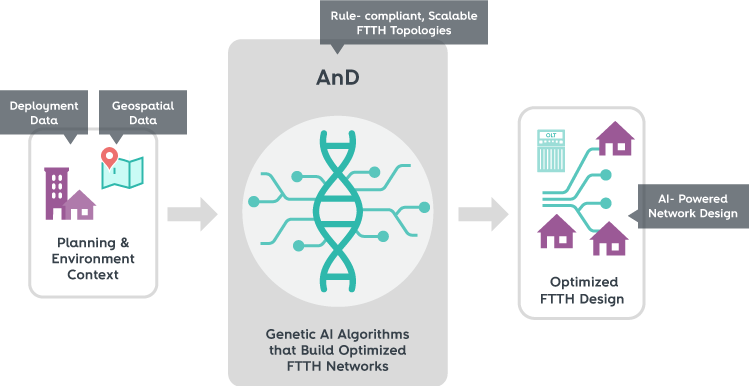
With NOSSIS Genius AnD, we set out to:
- Reduce network planning time from days to minutes.
- Introduce intelligent component placement under complex constraints.
- Increase scalability, consistency, and rollout speed.
- Deliver business value through significant cost savings and faster time-to-market.
NOSSIS Genius AnD represents a significant evolution from distribution-only network design towards fully autonomous end-to-end FTTH network planning. Built for both greenfield and brownfield scenarios, it intelligently places network elements while respecting technical and real-world constraints.
Beyond automation, NOSSIS Genius AnD presents multiple design alternatives, each optimized for different priorities such as cost, coverage, or efficiency. This gives planners greater flexibility and speed in decision‑making. Instead of manually iterating through designs, engineers can now compare scenarios instantly, select the topology that best fits their objectives, and ensure project standardization across all deployments.
In practice, this means what once took an engineer over a day to design can now be completed in minutes. NOSSIS Genius AnD not only accelerates FTTH deployment but consistently produces designs that can use fewer materials, reduce construction requirements, and increase operational reliability. The result is a scalable, automated design process that supports faster rollouts, greater consistency, and significant Capital Expenditure (CAPEX) and Operating Expenditure (OPEX) savings.
The Logic Behind NOSSIS Genius AnD
NOSSIS Genius AnD’s unique strength is its use of specialized algorithms, which are naturally well‑suited for complex, multi‑variable design challenges. In this context, these algorithms model every key FTTH component – from cables and termination points to customer types and splitter placements – and evolve network topologies over successive generations to optimize cost, efficiency, and technical compliance. As each generation progresses, weaker designs are discarded and stronger ones refined, allowing the system to converge on configurations that consistently outperform traditional, manually engineered plans.
To guarantee these designs are grounded in engineering reality, the agent incorporates real-world engineering and regulatory constraints, including optical power limits, cable lengths, material costs, and the reuse of existing infrastructure. And to ensure effectiveness, every generated solution is evaluated through a dedicated fitness function that scores it against total network cost while enforcing feasibility, blending physical‑environment data, equipment characteristics, and business logic into a single, practical decision metric.
It also extends this logic to brownfield scenarios, where the system accounts for duct availability, identifies obstructions, and adjusts routing to ensure cables follow viable, compliant paths. Additionally, it allows for the configuration of business-specific rules and priorities, making the system highly adaptable to local conditions and deployment scenarios.
After the design phase, NOSSIS Genius AnD can also identify overlapping construction requirements and group them into coordinated deployment clusters, helping streamline execution and improve operational efficiency.
Through this integrated process, NOSSIS Genius AnD transforms FTTH planning into a faster, more reliable, and highly optimized end-to-end workflow. The result is a coherent, cost‑aware topology that can use fewer materials and shorter routes, adheres to optical and power constraints, and reduces civil works by leveraging existing infrastructure wherever possible.
Delivering Concrete Benefits in Real-world Deployments
The impact of NOSSIS Genius AnD becomes most evident when we evaluate its performance in real deployment scenarios. Across multiple field tests and operational environments, the agent consistently delivered substantial cost reductions, dramatic time savings, and more efficient network designs compared to traditional manual planning.
In large‑scale tests using deployment datasets from real‑world operator‑grade inputs, including infrastructure, equipment catalogs, and design rules, NOSSIS Genius AnD generated optimized GPON topologies in minutes, achieving significant reductions in bill‑of‑materials (BOM) costs. To protect sensitive information, the datasets were anonymized and all location identifiers removed. Results are presented as consolidated ranges: across comparable areas, it delivered approximately 30%–52% BOM reductions, with end‑to‑end design times in the single‑digit to low‑teens minutes, depending on topology and constraints.
These outcomes reflect how the solution balances coverage, cost, and feasibility, minimizing components without compromising performance. The gains extend beyond time and material reductions, as embedding real‑world constraints into the design process enables the agent to avoid invalid plans. In brownfield contexts, this translates into reusing more of what already exists and trenching only where it’s truly needed. After design, NOSSIS Genius AnD also identifies overlapping construction activities and groups them into coordinated deployment clusters, streamlining execution and reducing deployment costs by around 15% by avoiding repeated mobilizations and redundant street work.
Taken together, the time reduction and cost optimization result in concrete operational benefits. NOSSIS Genius AnD delivers CAPEX reduction through fewer components and shorter routes, and OPEX reduction through accelerated planning cycles, fewer site visits, and less civil work. This combination leads to a faster, more scalable, and significantly more economical path to FTTH rollout without compromising the technical rigor required for long‑term performance and reliability.
Final Takeaways
Given the pressure shaping today’s FTTH landscape, operators must expand coverage faster and serve denser, more complex geographies while navigating increasingly constrained brownfield environments, all while controlling costs and ensuring consistent design quality. Conventional manual planning simply cannot keep pace with these demands, resulting in slow iterations, limited scalability, and inconsistencies across regions and teams.
NOSSIS Genius AnD changes this dynamic by turning FTTH planning into an intelligent, automated workflow. Instead of engineers spending days refining a single design, the agent evaluates thousands of possibilities in minutes, producing layouts that meet optical budgets, respect duct capacity, and align with business rules. It adapts to both greenfield and brownfield realities, generates alternative topologies for different priorities, and ensures that every design meets both technical requirements and real‑world feasibility.
Time-saving isn’t the only benefit NOSSIS Genius AnD delivers. It can reduce material and civil‑works requirements and minimize rework through constraint‑aware design. Its ability to identify overlapping construction tasks further trims cost and effort during deployment. Combined, these capabilities translate into measurable CAPEX and OPEX reductions, faster rollout timelines, and standardized quality across diverse geographies.
In a market where demand for fiber continues to grow and deployment environments become increasingly complex, NOSSIS Genius AnD offers a forward‑looking blueprint for how networks can be designed: faster, with greater certainty, and with intelligence embedded at every step. It raises the standard for what FTTH planning can achieve, and positions operators to scale easily into the next decade of fiber expansion. Combined with its native integration into NOSSIS Inventory within the NOSSIS One Operations Support System (OSS) suite, NOSSIS Genius AnD ensures a seamless transition from design to construction, establishing a unified, end‑to‑end workflow that supports continuous network growth. The result is a more predictable, scalable, and economically efficient approach to FTTH rollout.
NOSSIS Genius AnD has earned industry‑wide recognition for its transformative impact on network design, by being nominated for “Best Network AI Solution for Fibre Networks” at the 2025 Network X Awards, highlighting its innovative role in applying AI to next‑generation fiber planning, and for “Network Infrastructure Innovation Excellence” at the 2025 Broadband Excellence Awards, reinforcing its position as a pioneering solution redefining how operators approach broadband infrastructure automation.